
Special Offer -
Save big on your next home improvement project!
Tile Roof Underlayment Replacement (Lift & Relay) vs. Full Re-Roof

Tile Roof Underlayment Replacement (Lift & Relay) vs. Full Re-Roof: Which Do You Need?
Concrete and clay tile roofs are an iconic fixture across South Florida neighborhoods, defining the Mediterranean aesthetic of communities throughout Pembroke Pines, Weston, Fort Lauderdale, and Coral Gables. Homeowners choose tile because it is durable, impervious to coastal salt air, and engineered to endure for 40 to 50 years or more.
However, an unsettling situation frequently catches South Florida tile homeowners off guard: the tiles on the roof look completely intact and pristine from the ground, yet water is actively dripping into the attic or through the ceiling drywall.
When a roofing estimator assesses the situation, they usually present one of two options: a tile "lift and relay" (underlayment replacement) or a complete, full-scope re-roof.
Because a full roof replacement is a major capital investment, homeowners immediately want to know: Can I save money by simply lifting my existing tiles and replacing the water barrier underneath, or does local building code mandate a total re-roof?
As licensed roofing contractors in South Florida serving Broward, Miami-Dade, and Palm Beach counties, Florida Home360 specializes in high-velocity storm-resistant roofing. In this guide, we break down the hidden anatomy of tile roofs, examine the mechanics and true costs of a lift-and-relay, and help you determine which approach is the safest, most cost-effective path forward.
The Hidden Vulnerability of Tile Roofs: The Underlayment Lifecycle
To understand why a tile roof leaks while looking brand new, you have to look past the decorative exterior.
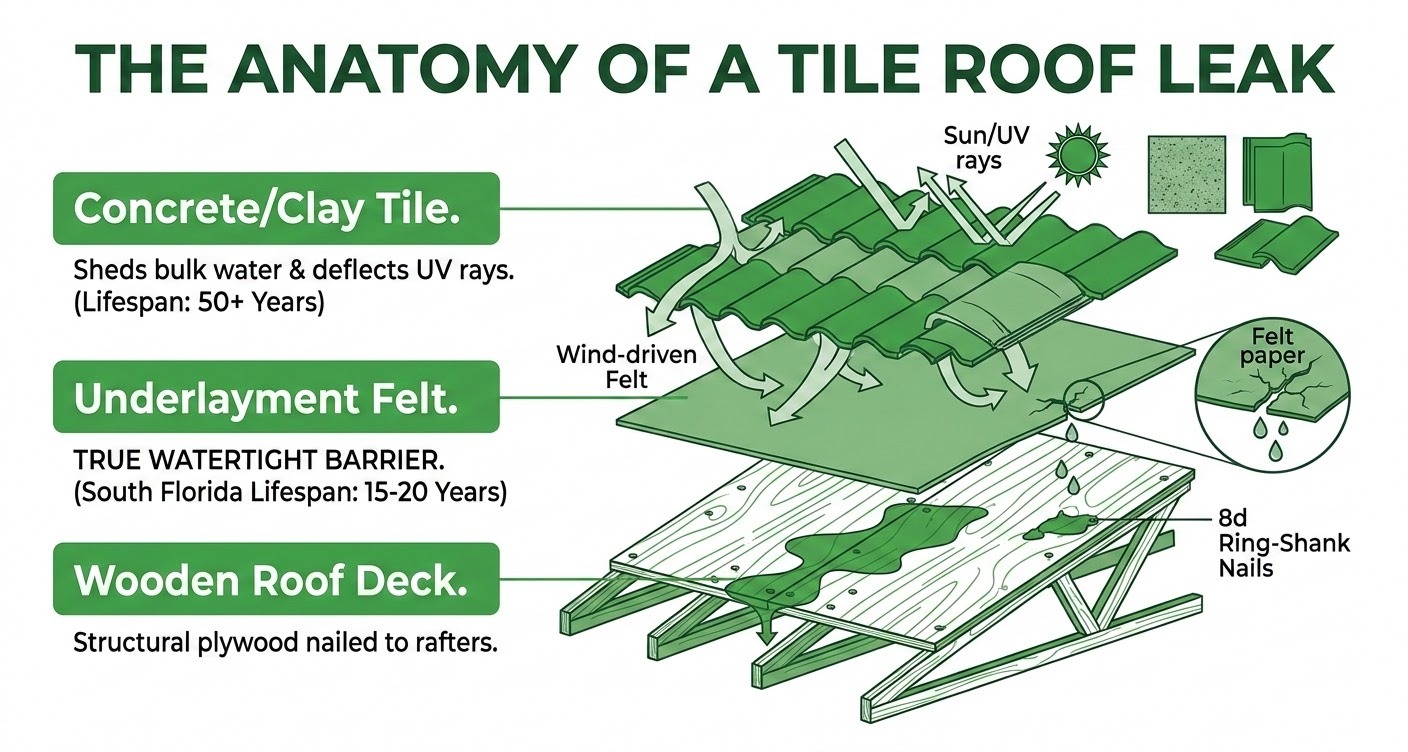
In modern South Florida roofing assemblies, concrete and clay tiles do not keep water out of your home by themselves. Tile functions as a structural shedding shield, it deflects sunlight, absorbs impact from flying branches, and sheds the bulk of rushing rainwater.
The true, continuous watertight seal protecting your attic is the underlayment membrane installed directly onto the plywood deck beneath the tiles.
The 20-Year Underlayment Cliff
In South Florida’s High-Velocity Hurricane Zone (HVHZ), temperatures directly beneath dark roofing tiles routinely exceed 130°F during peak summer months.
If your home was built or re-roofed before 2010, the installer most likely used traditional organic 30/90 organic asphalt-saturated felt paper or early fiberglass felts. Under decades of trapped, baking attic heat and high humidity, organic asphalt dries out, becomes brittle, and cracks.
Once that underlayment cracks, water trickling past the tile overlaps during wind-driven storms penetrates the sheathing, rotting your roof deck and entering your living room.
Option 1: What is a Tile "Lift and Relay"?
A lift and relay (also called a tile re-set or underlayment replacement) involves carefully removing the existing concrete or clay tiles, setting them aside on the roof or ground, stripping the rotted underlayment down to the wood deck, installing a brand-new secondary water barrier, and re-installing the original tiles.
The Obstacles of Lift & Relay in South Florida
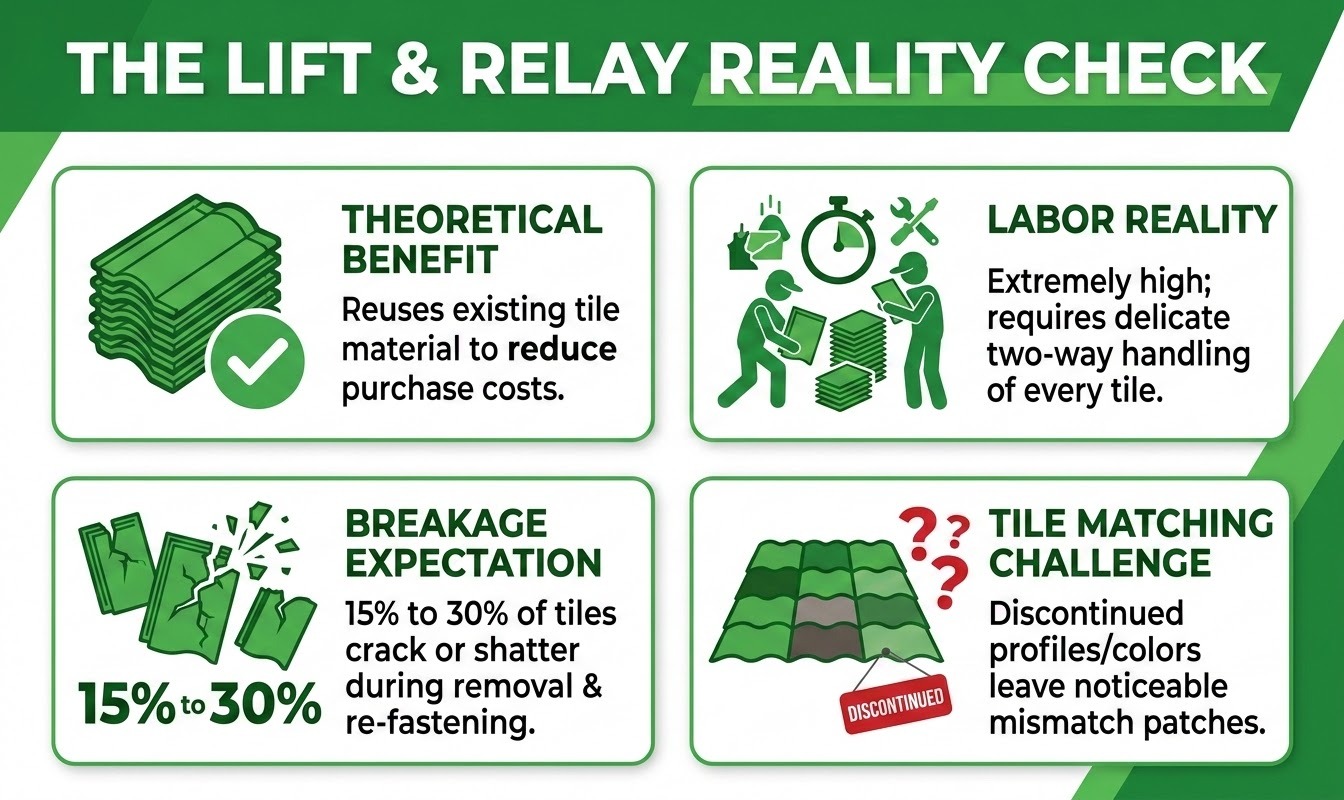
While a lift-and-relay sounds like a great budget compromise, it is fraught with hidden challenges that often make it impractical in our local market:
- High Tile Attrition & Breakage: Even the most careful roofing crews break tiles during the detachment process, particularly if the tiles were originally set in expanding adhesive foam or mortar beds. Expect to lose between 15% and 30% of your field and ridge tiles.
- Discontinued Tile Profiles: Concrete tile profiles, interlocking lugs, and color glazes change frequently. If your tile model was discontinued by the manufacturer a decade ago, finding salvage yard replacements that match your existing roof profile can be impossible. If the replacement tiles don't interlock seamlessly, the roof will fail city water tests.
- Equal Labor Costs: Stripping, cleaning, stacking, and relaying fragile old tiles is often more labor-intensive and time-consuming than laying down a brand-new, uniform tile system. Consequently, the labor quote for a lift-and-relay is often remarkably close to the cost of installing a fresh roof.
Option 2: The Full Roof Replacement
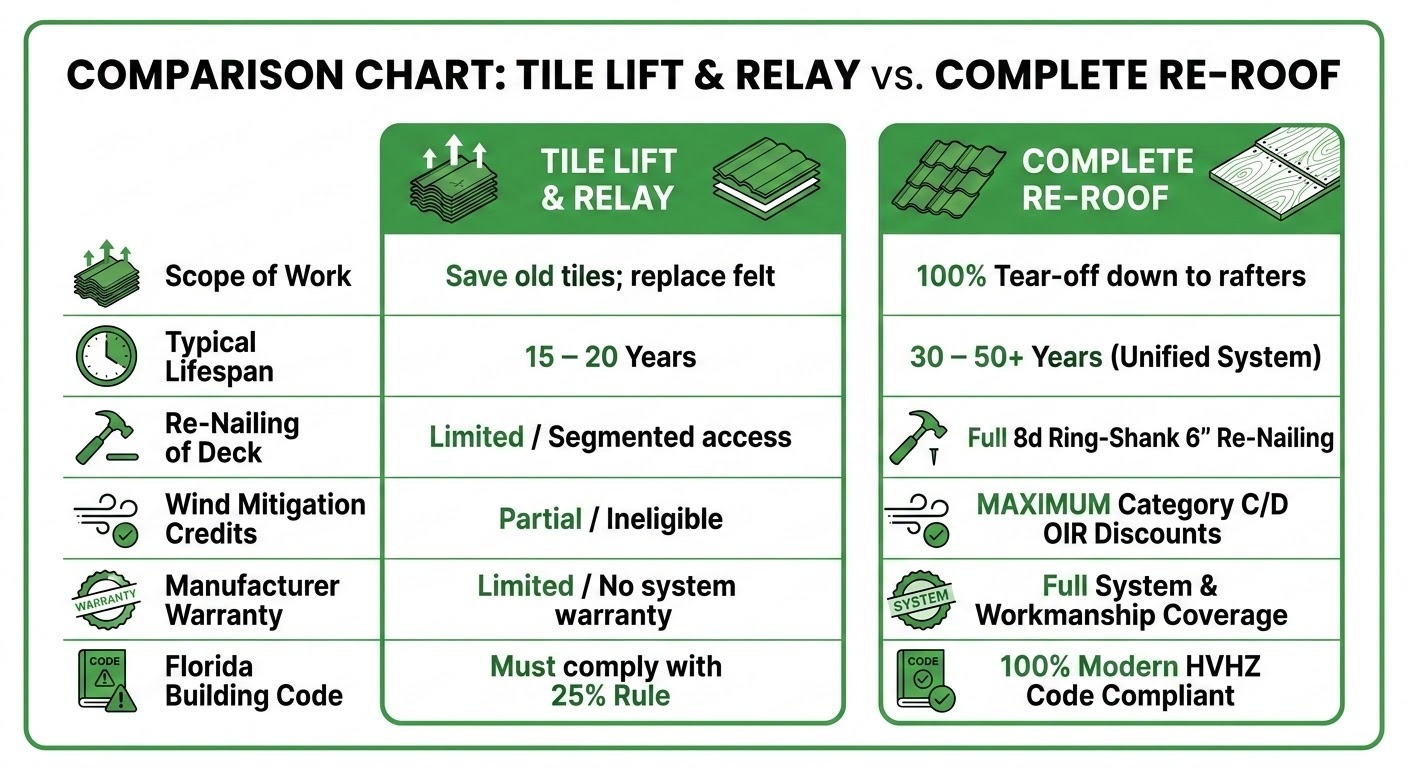
A complete re-roof involves a total tear-off down to the bare wooden rafters. The old tiles are discarded, the deteriorated underlayment is removed, and the structural plywood sheathing is fully exposed for inspection.
Why a Full Replacement Delivers Superior Long-Term ROI
Choosing a complete roof replacement offers decisive structural, legal, and financial advantages over attempting a piecemeal underlayment swap:
- Deck Re-Nailing & Structural Upgrades: With the deck completely clear, our crews can identify and replace rotted plywood sheets and drive heavy-duty 8d ring-shank nails every 6 inches along rafter joints, fulfilling modern HVHZ building requirements.
- Modern Self-Adhered Underlayment (SWR): Instead of outdated felt paper, modern replacements utilize advanced, high-temperature self-adhering modified bitumen underlayments (peel-and-stick). This seals every nail penetration and bonds directly to the wood deck, forming an impenetrable secondary water barrier.
- Maximum Insurance Premium Discounts: A full roof replacement triggers a brand-new Form OIR-B1-1802 Wind Mitigation Inspection. Upgrading the deck attachment and adding certified SWR underlayment slashes hundreds or thousands off your annual property insurance premium, savings a lift-and-relay rarely qualifies for. Learn how to read for OIR-B1-1802.
Florida Building Code & The 25% Rule
Before deciding on a lift-and-relay, you must consider local building regulations. Under the Florida Building Code (Existing Building Volume), any substantial reroofing project requires municipal permitting and inspection in Broward and Miami-Dade.
Furthermore, under updated statutory rules (Senate Bill 4-D):
- If your roof was permitted before March 1, 2009, any repair or alteration that exceeds 25% of the roof's total surface area legally triggers a mandatory, 100% complete roof replacement up to current High-Velocity Hurricane Zone codes.
- If your roof was permitted on or after March 1, 2009, you are legally permitted to repair or replace specific sections exceeding 25%, provided the replacement meets modern code standards.
Attempting an unpermitted lift-and-relay or bypassing city inspection can void your homeowner's insurance policy, fail property title searches during a home sale, and result in stop-work orders from municipal code enforcement.
Diagnostic Checklist: Which Do You Need?
Use this quick evaluation framework to see where your property stands:
A Lift & Relay May Make Sense If:
- Your roof was permitted within the last 12 to 16 years.
- Your tile is a common, currently manufactured profile with readily available spare stock.
- The leak is isolated to an accessible valley or flashing run, and the remaining underlayment is verified supple and intact.
A Complete Re-Roof is Mandatory If:
- Your tile roof is over 18–20 years old (the underlayment has reached the end of its chemical lifecycle across all slopes).
- You notice multiple leaks appearing in different rooms across the home.
- Your tile model is obsolete or out of production, making matching impossible.
- You want to qualify for substantial wind mitigation discounts on your homeowner's insurance policy.
- You want a comprehensive manufacturer and workmanship warranty covering the entire system.
Upgrade to Long-Term Peace of Mind with Florida Home360

When an aging roof begins leaking, patch jobs and piecemeal fixes only postpone the inevitable while leaving your interior drywall, flooring, and roof trusses at risk of catastrophic moisture rot.
At Florida Home360, we don't believe in cutting corners on your home's most vital structural defense. We specialize strictly in complete, high-performance, code-compliant roof replacements across Pembroke Pines, Fort Lauderdale, Miami, and throughout the Tri-County area.
Awards & Accolades

1000+ 5 Star
Google Reviews

A+ BBB
Rating

Angie Super
Service

GAF Master
Elite

Leader in
Energy Savings

